
Scripture
The letter and its recurring themes
The address in Revelation 2:12–17 speaks to a Christian community within Pergamum. It is a letter to people, not a description of a surviving church building.
- Faithfulness in a place described as Satan’s dwelling
- The witness of Antipas
- Compromise, teaching and communal discernment
- The hidden manna and the white stone
Read the complete passage in context before building an interpretation from one phrase.
Historical setting
The city behind the address
Pergamum was a former Hellenistic royal capital and a major center of culture, healing, civic religion and Roman imperial presence. Its acropolis, lower city and sanctuary landscapes belonged to different functions and periods.
The imperial cult is important to the city’s setting, yet the phrase ‘Satan’s throne’ has received several interpretations. Responsible guiding presents possibilities rather than announcing one archaeological object as the unquestioned answer.
Archaeological evidence
What the remains can tell us
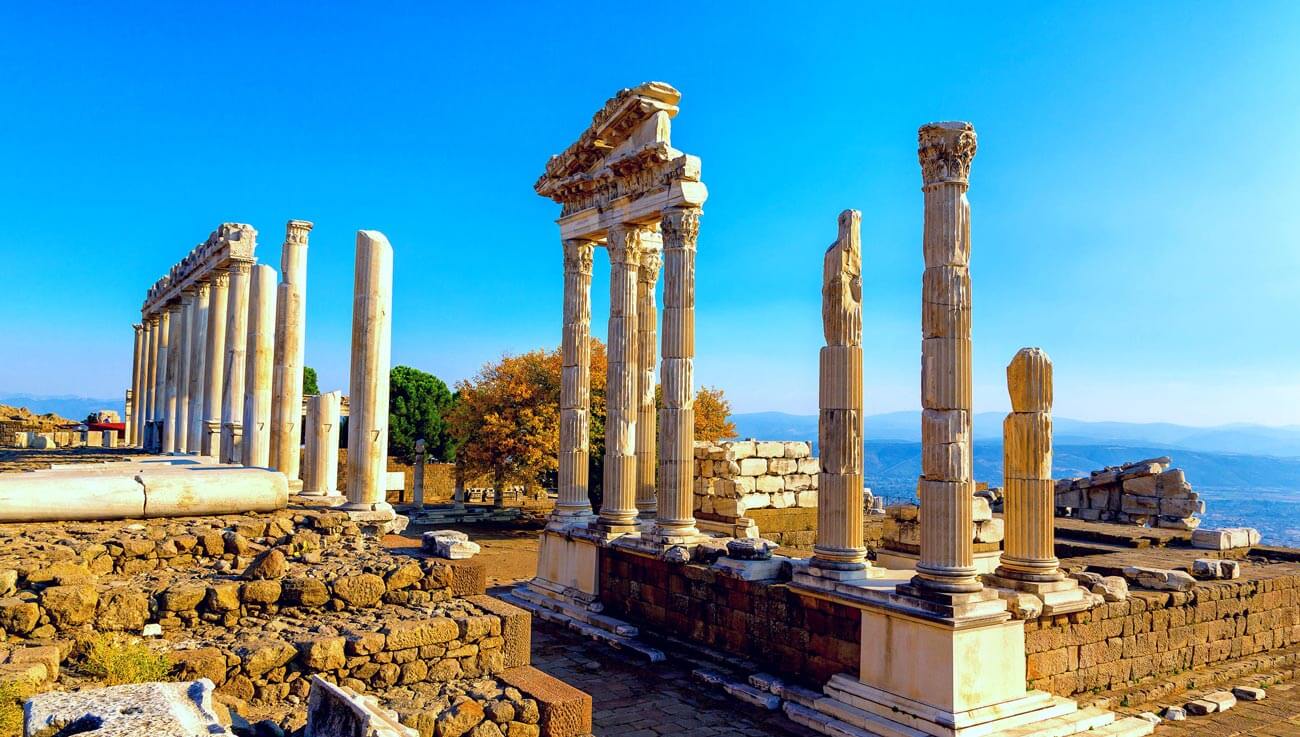
The acropolis includes the steep theater, temple foundations, terraces and the setting of the great altar whose surviving sculptural architecture is in Berlin. The Asclepion and Red Basilica broaden the city’s religious landscape.
The Red Basilica began as a monumental Roman sanctuary and later contained Christian churches. Those later adaptations should not be mistaken for the first-century congregation.
The Great Altar, imperial cult, acropolis and other features have all been proposed in discussions of ‘Satan’s throne.’ The wording of Revelation does not securely identify one surviving monument.
Visiting today
Read the place without overstating it
Pergamum rewards a slower visit because the view, topography and monuments carry different parts of the story.
The Red Basilica may be included when timing and group interest justify the lower-city stop.
Ancient city
Pergamum
Modern setting
Bergama
Primary text
Revelation 2:12–17
Continue exploring